Opt out available in most states… this one is for MA. Search for one in your state.
To opt out of the National Grid smart meter program in Massachusetts, you need to complete and submit an opt-out application form. If you choose to opt out, you will be billed a $26.00 fee for replacing your AMR meter with a non-AMR meter, and on a monthly basis, you will be billed an $11.00 meter reading fee1. If you have already received a smart meter and want to opt out, you can contact National Grid at 1-855-377-SMART (1-855-377-7627)2.
OPT OUT APPLICATION FOR MASSACHUSETTS (check your local ultility in other states)
https://www.nationalgridus.com/media/pdfs/billing-payments/ma_elecres_amr_opt_out.pdf
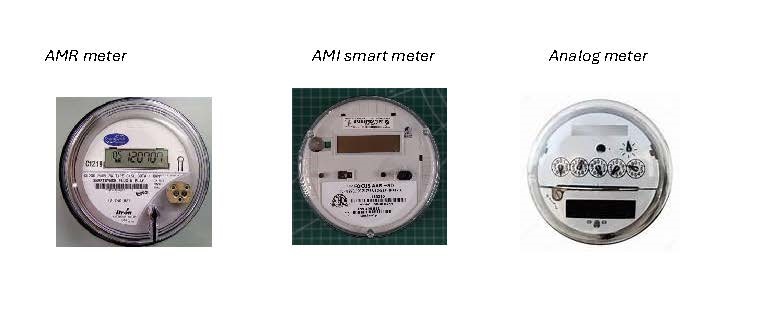
Note: many utility companies will offer AMI opt out and give you an AMR. You want an analog with the wheel indicators.. they will give you a hard time but persist!
What are AMR systems?
AMR systems are used by water and energy utility providers to collect consumer usage data from meters. AMR systems can record and gather consumption levels and status data remotely from consumers’ meters, resulting in a streamlined billing process. Once gathered, this usage data is transmitted with a device that uses radio frequencies from nearby cellular or radio towers. The information is then received by the water or energy utility’s billing system.
Remote meter reading saves utility providers significant time and resources. Automated meter readings can track consumer usage through truck rolls, meaning a utility worker simply has to drive by the meter’s location without exiting their vehicle.
What are smart meters?
According to the U.S. Department of Energy, AMI (i.e., smart meters) “provides a number of important functions that were not previously possible or had to be performed manually, such as the ability to automatically and remotely measure electricity use, connect and disconnect service, detect tampering, identify and isolate outages, and monitor voltage.”
AMI is somewhat more advanced and more costly than AMR. Unlike AMR systems, which utilize one-way communication from the utility provider to the customer, AMI uses two-way communication to transmit information. Because of this, smart meters can remotely start and stop services at locations, view real-time energy usage, identify power outages as soon as they occur, and provide better reliability.
Advanced metering infrastructure allows utilities to:
- Connect and disconnect services at both businesses and residences.
- Detect meter tampering and incorrect meter readings.
- Pay lower labor costs than AMR systems because manual truck rolls aren’t necessary.
- Dispatch repair crews for service requests, outages, and disruptions promptly and efficiently.
- Monitor usage and generate bills based on actual consumption, not just estimates or previous usage.
- Detect customers’ water leaks or large-scale system leaks remotely.
- Get automated alerts and status updates for the utility, field technicians, and customers.
Are AMR Devices Any Safer Than AMI Smart Meters?
Comparison of the safety of AMR meters versus smart meters for measuring electricity or water usage on a residential home or apartment and as a source of potentially health-altering EMF radiation. here are two common types of digital meters: Standard AMR (automated meter reading) and advanced smart meters.
AMR, sometimes referred to as ERT, provides a one-way wireless communication for utility companies, whereas smart meters have a two-way capability via connection to the SmartGrid.
Beware of some power companies that are claiming that the devices they are using are AMR, when they are, in fact, smart meters that communicate with the utility every 30 seconds or via collection towers. If it pulses on your EMF reader is an AMI.
Why would a consumer want to keep an old fashioned analog meter and forgo the improved technology offered by AMR or AMI smart meters?
The primary reason is dirty electricity and overexposure to EMF radiation.
An increasing number of people are finding that exposure to dirty electricity triggers or exacerbates health problems. While the effects of dirty electricity cannot be smelled, touched, seen, or felt, it is nonetheless very real and problematic for those who experience it.
The health effects of dirty electricity were first identified as early as the 1950s in rural areas when the behavior and feeding patterns of livestock were negatively affected by stray voltage caused by poor grounding and lack of utility infrastructure. In humans, the symptomatic effects can vary widely but commonly include:
- Headaches
- Difficulty sleeping
- Body aches and pains
- Ringing in the ears (tinnitus)
- Chronic Fatigue Syndrome
- Worsening of symptoms from multiple sclerosis or ALS (Lou Gehrig’s Disease)
Digital meters—whether or not “smart”—cause dirty electricity to flow through your home’s wiring. The problem is what is called the “switched mode power supply.” Switched mode power supplies are used to run the digital meter (whether a smart meter or a radio-off opt-out smart meter). In order for a smart meter to be powered, the 240 volts coming off the power line to the meter must be stepped down to 4–10 volts. A switched mode power supply is the device used to step down the voltage from 240 volts to 4-10 volts. This generates an enormous amount of what is commonly known as “dirty electricity” and referred to by electricians and electrical engineers as “voltage transients,” “voltage harmonics,” “line noise,” and “power quality issues.”
Beware of some power companies that are claiming that the devices they are using are AMR, when they are, in fact, smart meters that communicate with the utility every 30 seconds or via collection towers. If it pulses on your EMF reader is an AMI.
 S.A.F.E. Helps You